Three parts of the region, three very different French stories. Learners everywhere share the same problem: finding enough everyday practice in a language that competes with English for their time.
Ask about French in the Middle East and North Africa and you’ll get a different answer in every capital.
In the Gulf, the mood is upbeat. France’s ambassador to Saudi Arabia told Arab News he sees growing demand for places in Alliances Françaises and French schools, and the paper put the number of French speakers in the Kingdom at around 150,000, taught by some 500 teachers. It added that French has been gaining importance in the UAE and Qatar too.
In Egypt, it’s a matter of policy. A 2023 presidential decree made French a compulsory second foreign language in public schools from the first preparatory grade, starting in the 2024/2025 school year, and the Education Development Fund has since launched a free online French programme for young jobseekers, Al-Ahram Online reported.
In the Maghreb and Lebanon, the story is more contested. At the 2022 Francophonie summit in Djerba, President Emmanuel Macron acknowledged that French is less spoken in the Maghreb than it was two or three decades ago, according to Arab News. Algeria has introduced English in primary schools, and Morocco has been rolling out English teaching in middle school. In Lebanon, data from the Center for Educational Research and Development show English-language education gaining the upper hand since 2019-2020, with private English-language schools rising from 445 to 494 between 2018-19 and 2023-24.
A Language That Still Counts
None of that means French is fading from the map. The Observatoire de la langue française of the International Organisation of La Francophonie estimates that about 28.5 million people across North Africa and the Near and Middle East speak French, around 7.7% of the population covered, within a worldwide total above 324 million.
It also keeps a reputation as a language for work. An earlier Observatoire report, covered by Morocco World News, found that French speakers in the region tend to see it as modern and useful in business.
The picture that emerges is multilingual rather than zero-sum. Plenty of students and professionals in Casablanca, Beirut, Cairo or Riyadh are now juggling Arabic, English and French at once. That’s a lot to keep sharp.
Practice Is the Missing Piece
Whatever the country, the bottleneck looks similar. Policies change timetables, but they don’t create extra hours or extra teachers. When Egypt’s decree was signed, commentators were already asking where the teachers would come from. Families in the Gulf who enrol a child in a French programme, or adults in the Maghreb who studied French at school and want to keep it up alongside English, face a quieter version of the same problem: how do you practise a little, often, without it feeling like homework?
Games are one answer researchers have looked at closely. A systematic review of 28 studies on gamification in foreign-language learning found that vocabulary and grammar were the skills most often examined and that results mostly pointed to benefits. There are caveats. Much of that research focuses on English, and games tend to work best as practice that sits alongside real teaching. But the logic is simple: people repeat what they enjoy, and repetition is what a language runs on.
One Example: LudoFrançais
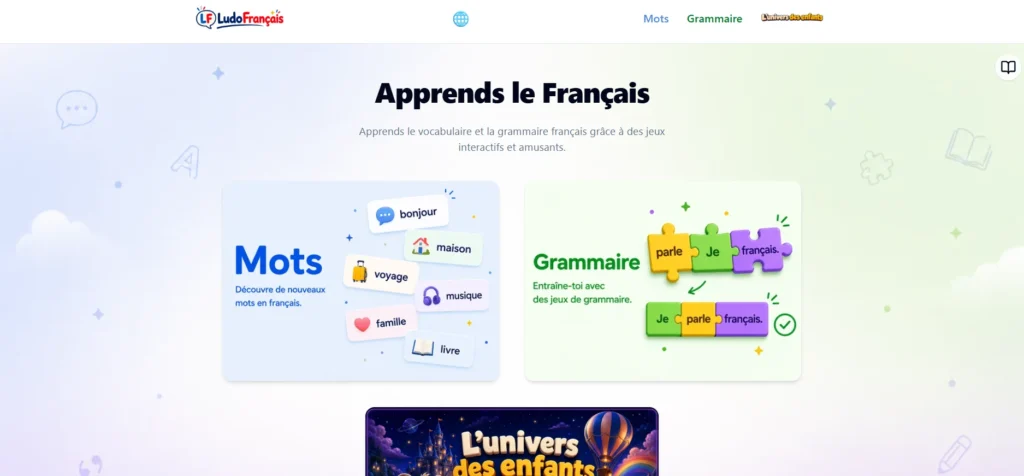
One French-language option for learners anywhere in the region is LudoFrançais, a site that sums up its method as seeing, listening, playing and learning. The site itself is in French, so it suits learners who already have a few basics, and its aim is to meet words in context rather than in lists.
You can see that in the vocabulary games. There are ten, from a hangman-style word game to memory pairs and word searches. One of them, Habille-moi, asks you to pick the right outfit for a situation, which ties a word to a picture and a purpose.
On the grammar side there are nine activities. In the passé composé game you match verbs to their correct forms, and another turns telling the time into a trip around France. Students who need a quick reference can use the irregular verbs table, sorted by level from A1/A2 up to B2, with the present, future, conditional and past participle of each verb and an example sentence.
Parents of younger children will find a separate section for kids, with audio, picture-based vocabulary games and rewards. And the site’s partner map lists schools or teachers in France, India and Egypt, so at least one of its partners sits inside the MENA region.
A few honest limits. The site doesn’t publish learning-outcome data, so there’s no telling how much any one learner will gain. The pages we reviewed show no sign-up wall, and visitors who like the project are invited to support it with a donation. Whether it suits a particular learner is something only practice will show.
Keeping French in the Mix
The region’s language map is being redrawn from several directions at once: English expanding in schools, French holding firm in some places and growing in others, and Arabic at the centre of it all. For learners, that makes small, regular practice more valuable, not less. Teachers and schools will carry most of the work. But a few minutes a day with something that feels like play may be what keeps a second or third language from slipping.
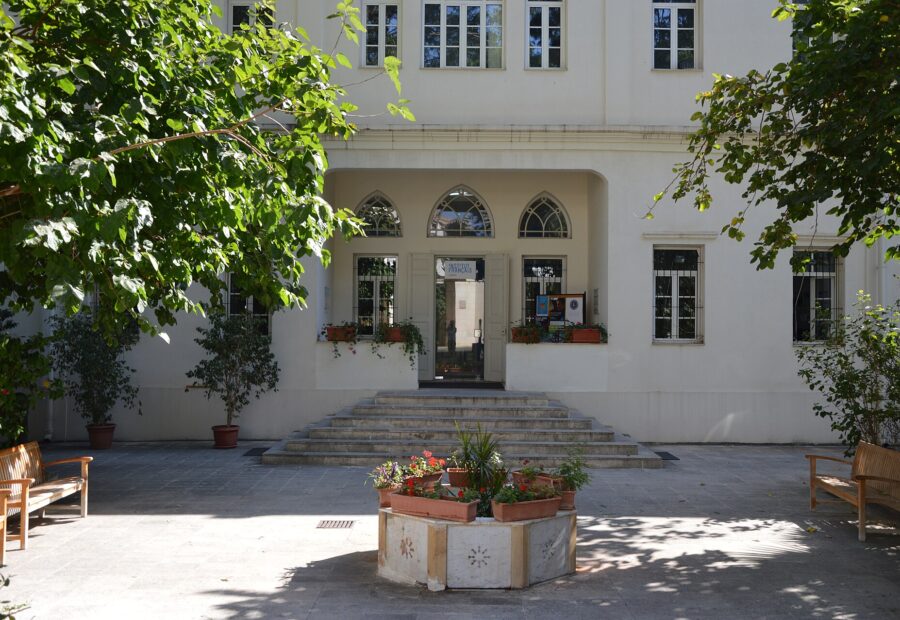
Featured image: Entrance of the Institut français du Liban, Beirut. Photo: Benjamin Carrot, via Wikimedia Commons, CC BY-SA 3.0.
Read more
 EFE UAE Launches AJYAL 2026 Program at AURAK to Equip Youth with AI, Green Skills and Job ReadinessMay 19, 2026
 STEM Best Practice Summit and Awards 2024: Celebrating Excellence in STEM EducationJuly 19, 2024
 New Salam platform to offer opportunities to Saudi youthJune 13, 2022
 Dubai schools to remain closed on Monday, 16 May, KHDA says following death of UAE President Sheikh KhalifaMay 13, 2022